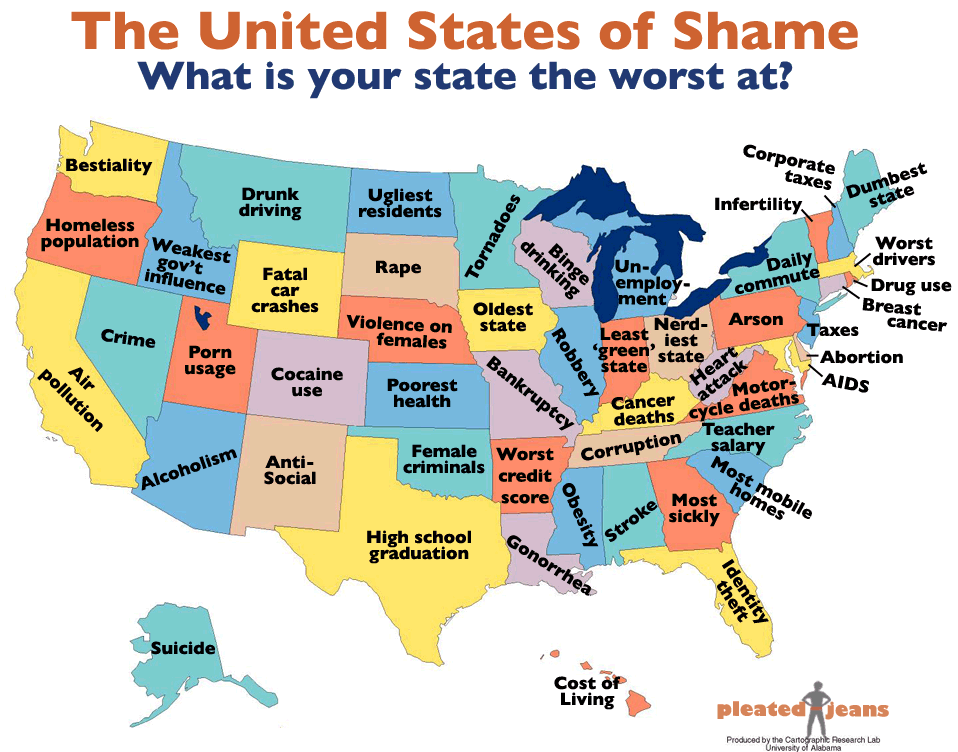
http://pleated-jeans.com/2011/01/24/the-united-states-of-shame-chart/

RIT’s recently opened Ctrl Alt Deli (pronounced “Control Alt Deli”) has a name that possibly only a computer geek could love—and, fortunately, RIT has no shortage of them.
The deli’s moniker pays tribute to the so-called “three finger salute” (the personal-computer keyboard combination—Control+Alt+Delete—used to reboot a computer).
It has been described as “the nerdiest deli” in America. And, you know, that sounds about right. After all, not many menus begin this way:
C:\>dir Design_Your_Own_Sandwich
The eatery—featuring “Mega Byte” and “Half Byte” sandwiches—is located, appropriately, in the atrium of Building 70, home to RIT’s B. Thomas Golisano College of Computing and Information Sciences. That means the 2,363 computer geeks—’er make that RIT students majoring in computer science, information technology, interactive games and media, networking, systems administration, and software engineering—help ensure a steady flow of customers.
Michael Chin, a first-year computer science major from the Bronx, N.Y., submitted the winning entry—one of eight suggestions—in a naming contest.
“I thought, how can I infuse something about computers that is easily recognizable and that everyone would know, and include something about the deli with it? Then I glanced at my keyboard, and the rest was history,” Chin recounts. “I was proudest of this one.”
Though he has patronized the deli only a handful of times since it opened, he plans to return.
“I’ve wanted to stop by for a visit and say something along the lines of, ‘Hey, I named this deli. Pretty cool, huh?’ But I haven’t as of yet.”
An announcement about the deli, “tweeted,” fittingly enough, on Twitter, drew instant response.
“This might be the nerdiest deli in the United States,” mused RIT alumna Kayla Zerby ’05 (professional and technical communication), tweeting from Newport Beach, Calif. “Yeah, I want mayo. No, wait. Ctrl+Z. Mustard.”
“At first, I thought, ‘You’ve got to be kidding,’” adds Zerby, who recently relocated to New York City. “But it quickly switched to, ‘This is genius. Talk about knowing your customers.’”
The Ctrl Alt Deli joins another on-campus outlet with a digital-age-themed name, Bytes on the Run, a “grab-and-go” convenience store that opened in the fall in RIT’s Student Alumni Union.
“Nerdiest convenience store” and “nerdiest deli” in the nation? Sure, that sounds about right. And at RIT, that’s a badge of honor!
http://www.rit.edu/news/?v=47222Phoenix, Arizona, police officer David Lake had filed a federal lawsuit against the city alleging employment discrimination.
He’d also filed a public records request to obtain documents related to his work, including notes written by his supervisor documenting his performance. When he subsequently sought the electronic metadata for the records, because he believed at least one of the paper documents had been backdated, the city refused.
The city argued that metadata — digital information that can reveal when a document was created and subsequently accessed or modified — was not part of the public record. Releasing such information to the public would result in an “administrative nightmare” and force public officials to spend “countless hours” trying to identify the metadata, the city claimed.
Two lower courts agreed with the city, noting a distinction between “record” and “public record.”
But the state Supreme Court ruled on Thursday that “if a public entity maintains a public record in an electronic format, then the electronic version, including any embedded metadata, is subject to disclosure (.pdf) under our public records laws.”
Supreme Court Justice W. Scott Bales wrote in the ruling that metadata “is part of the underlying document; it does not stand on its own. When a public officer uses a computer to make a public record, the metadata forms part of the document as much as the words on the page.”
The court responded to the city’s claim that supplying metadata would place an unnatural burden on city workers by noting that the request for metadata could easily be satisfied by supplying requesters with documents in their original electronic format, rather than printing them out.
Several media organizations, as well as the Reporters Committee for Freedom of the Press, wrote an amicus brief in support of Lake’s request.
“The decision is important because we live in an electronic age where maintenance and preservation of public records in electronic format is quickly becoming the norm,” said David Bodney, who helped write the brief. “Public bodies should not be permitted to withhold that information from public inspection.”
Although the ruling applies only in Arizona, the case could influence other courts. The Supreme Court in Washington state is set to hear a similar metadata case.
(Hat tip: Reporters Committee for Freedom of the Press)
 Buy a pair of socks, become a star in Times Square
Tuesday, AE (AEO) will announce plans to turn the 25-story electronic billboard above its flagship store at one of the world's busiest intersections into a social-media icon. Anyone who buys something in the store beginning Nov. 19 can have their photo and a message posted on the billboard within 15 minutes of the purchase.
As the critical holiday shopping season kicks off, marketing is all about going viral. The chain will nudge customers to snap a photo that marks the moment and to share it with friends via Facebook, Twitter or any social media. Like all teen-targeting retailers, AE is pushing the marketing envelope to get teens to chat about the brand online.
The idea: You don't have to be a celebrity to have your mug posted at Times Square.
"Narcissism knows no bounds in Times Square," says Tim Tompkins, president of Times Square Alliance, which represents area businesses. "I suspect this will become part of the Times Square experience." He says roughly 500,000 people walk through Times Square daily.
Still holding onto that DVD collection? (If so — why?) Well, Disney doesn't think you need to anymore. Nope, all you need, according to the company, is its "Keychest." Well, and a television, computer, cellphone or that sort of thing.
So what's Keychest? It's a distribution platform being developed by Disney and Apple that makes it so when you purchase something — a movie being the easiest example — you'd be able to use that something over a variety of platforms. Buy Iron Man, say, and you could then watch it on your computer, television or portable what-have-you. That's because once you've made the purchase through keychest, you'll get a keycode that'll unlock said purchase.
If you think about it, it's a lot like a DVD, just a digital one. After all, you can use a DVD on any device capable of playing them, but — thanks to DRM — if you bought a movie on the Xbox Marketplace, you wouldn't then be able to turn around and magically play it on a different machine.
Disney isn't the first one to think of a cross-platform distribution method, though we're definitely pro any idea that shakes up the horribly insular nature of today's DRM media.


